
Scuba diving in the Ría de Arousa by boat: dive sites, season and how to plan it
Scuba diving in the Ría de Arousa from a private skippered boat takes you to rocky reefs, nudibranchs and seagrass you'll never reach from shore: here's where, when and how to plan your dive trip from Vilanova de Arousa.
Every season, groups of divers message us with the same question: "Can you take us diving around the ría?". And every time it makes us a little happier, because the Ría de Arousa is one of the best-kept diving secrets in northern Spain. We rent out our skippered boat from the port of Vilanova de Arousa. We are not a dive centre — and it's worth being clear about that from the start — but we are the boat that puts you right above the dive site, waits for you on the surface and gets you back on board with a hot coffee. In this article we tell you, honestly, what to expect underwater, when it's worth it and how to organise it properly.
Why dive the Ría de Arousa
Divers coming from the Mediterranean often arrive with preconceptions: cold water, poor visibility, nothing to see. They're wrong about the last one. The Ría de Arousa is the largest of the Rías Baixas and one of the most productive marine areas in Europe. Nutrient-rich Atlantic water feeds a food chain you can feel on every metre of the seabed.
What makes it special for diving:
- Sheer density of life. The same waters that grow the mussels on the bateas (mussel rafts) feed kelp forests, anemones, sponges and an invertebrate fauna that surprises even divers with hundreds of logged dives.
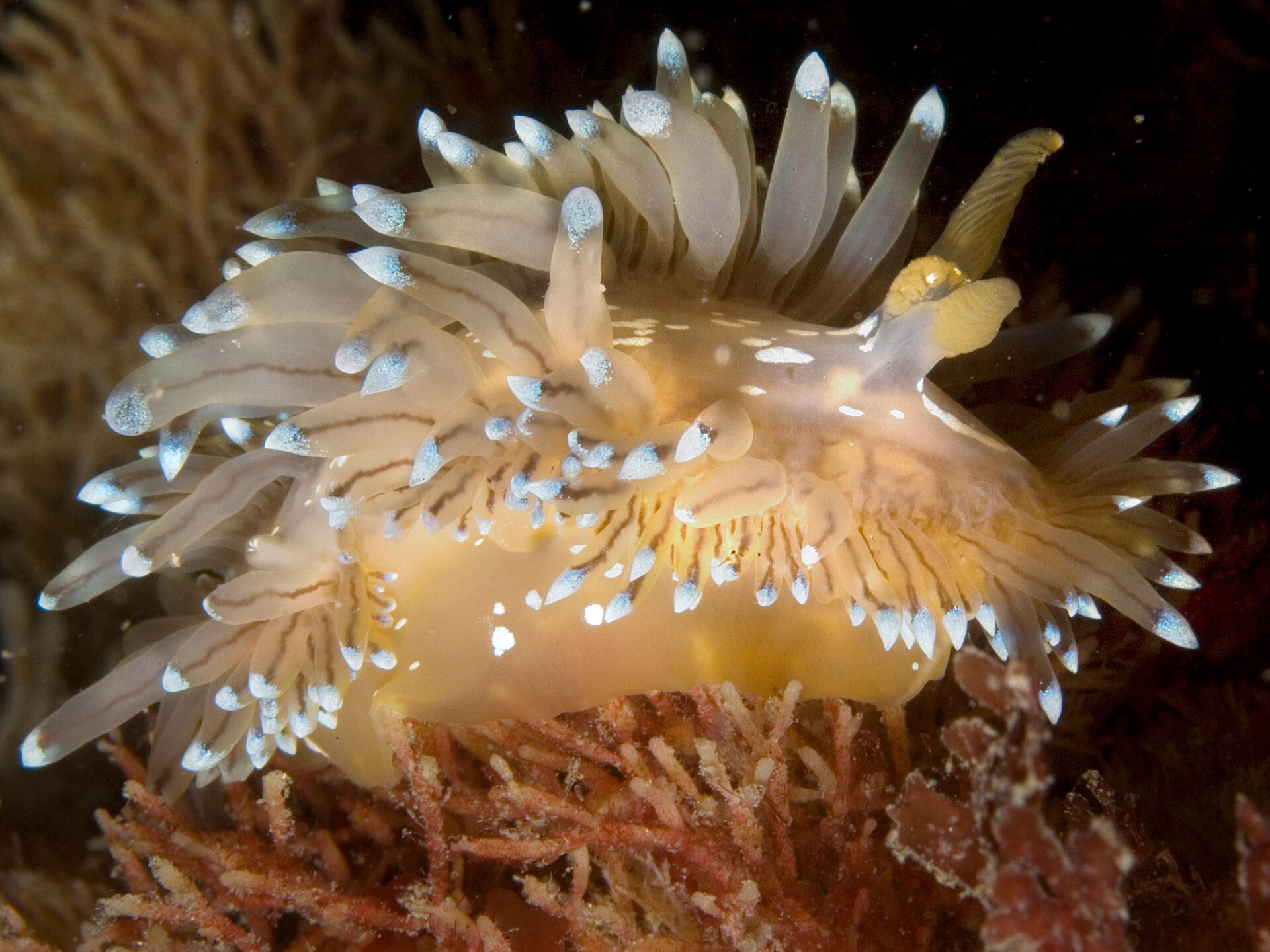
- A macro paradise. If you're into underwater photography, you'll love it here: nudibranchs in impossible colours, blennies peeking out of their holes, see-through shrimps, octopus and cuttlefish that change colour as they spot you.
- Varied seabeds. Granite reef with cracks and boulders off the points of the Illa de Arousa, sand and seagrass in the shallows, and deeper walls towards the mouth of the ría.
- Sheltered water. The ría is protected from the open ocean by the O Grove peninsula and Sálvora island, so you can dive on many days when the Atlantic outside won't let you.
What you'll see underwater
We won't promise you manta rays or sharks: this isn't about big pelagics. It's about looking closely. On a typical dive in the ría you'll often come across:
- Nudibranchs like the Antiopella cristata in the photo, flabellinas and dorids of every colour.
- Octopus hiding in the cracks (yes, the same ones that end up as pulpo a feira) and cuttlefish over the sand.
- Velvet crabs, spider crabs and lobsters among the rocks.
- Schools of bream, pollack, ballan wrasse and pouting around the boulders.
- Starfish, sea urchins and gorgonians in spots with a bit more current.
And on the surface, if you're lucky, a visit from the bottlenose dolphins that live in the ría and sometimes come up to the boat while we wait.
When to dive: season, temperature and visibility
Here are the real figures, which is what you need to plan:
Water temperature
In the Ría de Arousa the water ranges from 13-14 °C in winter to 18-20 °C in late summer. In October it is still around 15-16 °C. With a 7 mm semi-dry suit (or a drysuit if you have one) you can dive comfortably almost all year round.
Visibility
This is the variable that changes most. On good days in late summer and early autumn we've seen 8-12 metres; after storms or with heavy plankton in spring it can drop to 3-5 metres. Tides, the wind over the previous days and rain are what decide it. That's why it helps so much to have a skipper who knows the ría: if one spot is murky, we can be at another in fifteen minutes.
The best time of year
For us, June to October. September and October are usually the best months: the water still holds the summer warmth, the plankton has dropped off and the ría is much quieter in terms of boat traffic. If your dates are flexible, this is the moment.
Dive areas we can take you to
We choose the spot depending on the day, the group's level and the conditions. Some of the areas we work most often:
The rocky points of the Illa de Arousa
The rocky points of the Illa de Arousa, around the Punta Cabalo lighthouse and the Carreirón natural park, combine granite boulders, cracks and seaweed at friendly depths (8-18 metres). Ideal for newly certified divers and for macro photography.
Around Areoso
Around the islet of Areoso the seabed is shallower and sandier, with seagrass meadows where cuttlefish and flatfish hide. Perfect for a shallow second dive, or so that non-diving companions can snorkel in the meantime.
Towards the mouth of the ría
For more experienced divers, the shoals and walls of the outer ría offer more depth and more pelagic life. Note: the Sálvora area is part of the Atlantic Islands National Park, and scuba diving there requires prior authorisation from the Park. If you want to include it, it has to be arranged in advance; we'll point you in the right direction.
What we don't do: dive under the bateas. They're private installations, with ropes and the mussel farmers' boats manoeuvring around them, and they're not a safe place for a diver. We see them — plenty of them — from the boat.
How we organise a dive trip
To make sure everything goes smoothly, this is how we work:
- Message us with your dates, number of divers and certifications. We recommend a maximum of 4 divers with full kit: the boat is 8.5 metres long and takes up to 6 people plus the skipper, but tanks and BCDs take up space and we want you to be comfortable.
- You bring your own gear or rent it from a local dive centre. We don't rent tanks or dive equipment. If you come without gear, we recommend arranging it with a dive centre in the area, which will also refill your tanks.
- Independent diving, between certified divers. Each diver must hold a valid certification and dive insurance, and plan the dive with their buddy. If someone in the group isn't certified and wants to try a discovery dive, that must be done with an instructor from a dive centre; we can take the instructor on board.
- The skipper stays on the surface. We anchor or drift while watching your bubbles, with the Alpha flag raised as required by law, and pick up the group when it surfaces. A surface marker buoy (DSMB) is essential.
- Between dives, surface interval on board: sandwiches, something hot and a chat while we sail to the second site.
Prices and logistics
- Half day (4 hours): €300 — enough for one relaxed dive or two short ones near Vilanova.
- Full day: €500 — two dives in different areas with a long surface interval, or a trip out towards the mouth of the ría.
- Fuel extra, depending on the distance covered.
- The price is per boat, not per person, so with four divers the cost is shared.
We always depart from the port of Vilanova de Arousa, with parking nearby to unload your gear. If the forecast doesn't cooperate the day before, we'll let you know in good time and move the date at no cost.
Tips from people who know the ría
- Bring a hood and gloves, even in summer. You'll be glad of them at 15 metres.
- Check the tide tables: dives at slack water usually have less current and better visibility. We plan the departure time around that.
- Bring a torch, even on day dives: the colours of the nudibranchs and red algae fade beyond 10 metres without light.
- Respect the wildlife: shellfishing here is regulated and spearfishing has its own rules. Look, photograph and leave everything as you found it.
- If the group includes non-divers, the plan still works: while some go down, others can snorkel at Areoso or stay on board enjoying the ría.
Book your dive trip in the Ría de Arousa
If you have a group of divers and want to discover the Ría de Arousa from the inside, message us on WhatsApp at +34 685 74 24 20. Tell us your dates, how many of you there are and your level, and we'll suggest the sites and times that best match the tide. Autumn is still a great time to go down: the water is mild and you'll have the ría to yourselves.
Photos: Peter Southwood — CC BY-SA 3.0; Olivier Dugornay (Ifremer) — CC BY 4.0; via Wikimedia Commons.
Ready to experience the Arousa estuary onboard?
Full day €500 · half day €300 · fuel extra. Book on WhatsApp and we confirm in under 4 hours.
Book by WhatsApp

