
Is it safe to charter a boat on the Ría de Arousa? How we handle safety on board
Safety on a skippered boat charter in the Ría de Arousa: life jackets, insurance, weather calls, our rules with children and what happens if conditions change, explained by the people who sail here every day.
Almost every week someone messages us with the same question, phrased in different ways: "My partner is a bit scared of the water", "We're coming with a four-year-old — is it safe?", "I've never been on a small boat". It's a very sensible question and it deserves a serious answer, not just "don't worry, it's fine". We charter our own skippered boat from the harbour of Vilanova de Arousa, so here is exactly how we approach safety on board: what we carry, which decisions we make and why the Ría de Arousa is, of all the Rías Baixas, one of the gentlest places to take your first trip out to sea.
The Ría de Arousa: large, sheltered and very well known
The Ría de Arousa is the largest of the Rías Baixas, and it has an advantage people rarely mention: much of its inner area is protected from the open ocean by geography itself. The Illa de Arousa, the O Grove peninsula and the Barbanza coast act as a shield against the Atlantic swell. So while there may be a groundswell at the mouth of the ría, the water between Vilanova, the Illa de Arousa, Areoso and the Punta Cabalo lighthouse is usually far calmer.
It's also a ría full of activity: the mussel rafts (bateas), shellfishing boats, local boats from the harbours of Vilanova, Cambados and Vilagarcía… You are never sailing somewhere isolated. There's always someone nearby and the shore is only minutes away.
The skipper: the cornerstone of safety
Our boat always goes out with a professional skipper. That's not a comfort extra — it's the foundation of everything:
- They know the shallows, currents and tides of the ría, which change a lot between high and low water. Sandbanks like Areoso almost surface at low tide.
- They read the wind. In summer and early autumn the northeasterly (nordés) tends to build in the afternoon, so the skipper plans the more exposed parts of the route for the morning.
- They choose where to anchor and where to swim, always away from traffic and the mussel rafts, in coves with sandy bottoms and clear water.
- They keep an eye on the group the whole time: who's feeling seasick, who's cold, who's nervous.
That's why, even if you come with no experience or licence at all, you don't need to know anything about boating. You enjoy; we sail.
What we carry on board
Our boat is 8.5 m long with a 2.65 m beam and is certified for 10 people. Even so, we take a maximum of 6 passengers plus the skipper. That's partly about comfort, but also about safety: there's plenty of room to move around, sit in the shade, and nobody has to stand along the side.
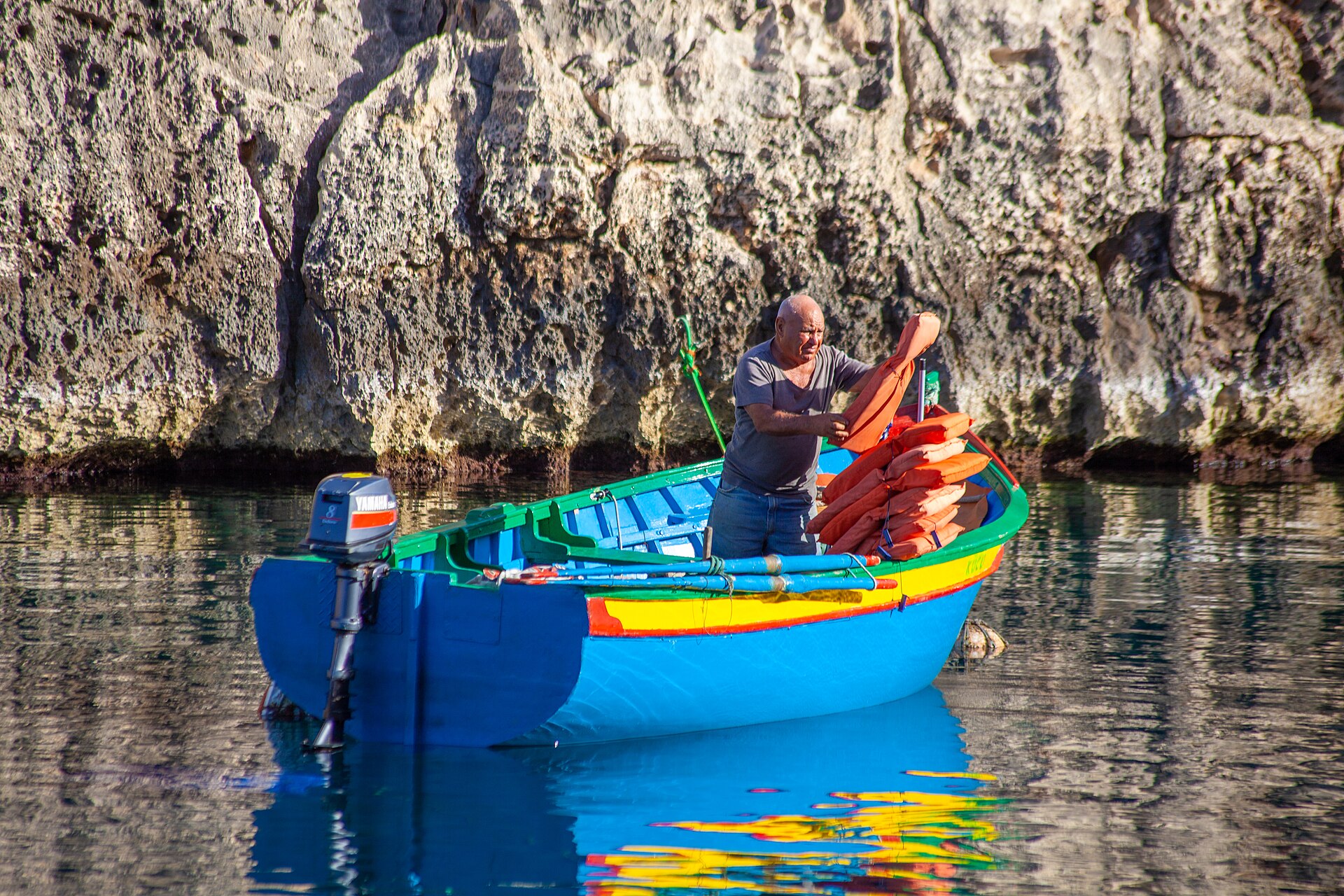
On board you'll find:
- Life jackets for every passenger, including children's sizes. If you're bringing kids, tell us their ages and weights so we have the right jacket ready.
- A lifebuoy with line, plus the rest of the safety equipment required by regulations for the area we sail in.
- A VHF radio and mobile phone to contact the harbour or Maritime Rescue (Salvamento Marítimo) if ever needed.
- A first-aid kit.
- A swim ladder to climb out of the water easily, and a bimini for shade.
- Insurance for the boat and passengers, included in the price.
Before casting off, the skipper always gives a short safety briefing: where the life jackets are and how to put them on, how to get on and off, where to hold on when the boat picks up speed, and what to do when swimming.
With children: our house rules
Families with little ones are among our favourite guests, and that's exactly why we're strict:
- Children wear their life jacket while under way, not just keep it "within reach".
- When the boat is moving, little ones stay seated in the middle or at the stern, never on the bow.
- Swimming happens with the engine off, the boat at anchor and an adult watching at all times.
- For the youngest we suggest short routes in calm water: around O Carreirón on the Illa de Arousa or the beaches inside the ría.
If you're unsure whether your child is "too young", just ask. We'll tell you honestly whether the trip will suit them.
If the weather changes: the forecast decides
In Galicia the weather is part of the trip. We check several forecasts (wind, swell, tide and MeteoGalicia and AEMET warnings) in the days before and on the morning of your trip. Then:
- If the forecast is good, we head out on the route you chose.
- If there's strong wind at the mouth of the ría, we switch to sheltered areas: the Illa de Arousa, Areoso, the Vilanova coastline or the inner mussel rafts. There's a beautiful route almost any day.
- If it isn't safe to go out, we don't. We'll offer you a free change of date or a full refund of your deposit, whichever you prefer.
We will never push a trip just to avoid losing a booking. We wouldn't wish a bad time at sea on anyone — and it would be the worst possible advertising for us.
If you get seasick or are afraid of the water
Seasickness is the most common worry and, in the ría, also the easiest to manage. Because the water is sheltered, the motion is usually gentle. Still, we recommend a light breakfast, keeping your eyes on the horizon and not sitting in the cabin or on the bow if there's some chop. If someone feels unwell, the skipper looks for calmer water or anchors for a while — on a private boat there's no fixed schedule to keep.
If someone in your group is afraid of the water or can't swim, that's fine: they can wear a life jacket the whole time and simply not swim. Many people who step aboard nervous end the day asking to come back. The key is going at their pace, and that's only possible when the boat is just for you.
What we ask of you
Safety is a shared job. We only ask a few things:
- Light-soled or rubber-soled shoes that don't slip (or go barefoot on board).
- Sunscreen, a cap and a warm layer: it's always cooler at sea than on land, even in summer.
- Drink in moderation. A glass of Albariño at anchor off the Illa de Arousa is part of the experience; overdoing it isn't.
- Follow the skipper's instructions. There's always a reason.
- Let us know about allergies, medication or any medical condition we should be aware of.
Useful numbers at sea
Just so you know (and for peace of mind): at sea in Spain, the Salvamento Marítimo emergency number is 900 202 202, along with 112, and on the radio VHF channel 16 is used. There are rescue boats based in several harbours across the Rías Baixas, and the ría is closely watched. It's information we hope you'll never need, but the skipper always has it to hand.
Prices and booking
- Half day (4 hours): €300
- Full day: €500
- Fuel extra, depending on the route.
The price is for the whole boat, for up to 6 people plus the skipper, and includes skipper, insurance, life jackets and snorkelling gear. No small print.
Any questions about safety? Ask us
If you're coming with children, an older relative, someone who's afraid of the water, or you simply want to know more before booking, message us on WhatsApp at +34 685 74 24 20. We'll explain how your trip would work, which route suits your group best and what the forecast looks like for your dates. Sailing the Ría de Arousa with a skipper is one of the calmest, safest ways to discover the Rías Baixas.
Photos: Contando Estrelas — CC BY-SA 2.0; Godwin Borg — CC BY-SA 4.0; via Wikimedia Commons.
Ready to experience the Arousa estuary onboard?
Full day €500 · half day €300 · fuel extra. Book on WhatsApp and we confirm in under 4 hours.
Book by WhatsApp

