
Shellfish gathering in the Ría de Arousa: watching the mariscadoras at work from a boat
Shellfish gathering in the Ría de Arousa is a spectacle almost no tourist sees: here is how, when and where to watch the mariscadoras, the clam beds and the mussel rafts from our boat, departing from Vilanova de Arousa.
Something happens every low-tide morning in the Ría de Arousa that most visitors never get to see: hundreds of women in rubber boots, rake in hand and bucket at their side, walk out onto the sandbanks to gather clams and cockles. This is marisqueo a pie, shellfish gathering on foot, a centuries-old trade still alive in Vilanova, Carril, Cambados, A Illa de Arousa and O Grove. We rent out our boat here, from the harbour of Vilanova de Arousa, and we see it almost daily. It is one of the things that most impresses people who come aboard without expecting it.
In October the subject is especially timely. After the summer, the fishermen's guilds open the shellfish season and the banks fill up with people at work. If you want to truly understand why the seafood from this estuary is the best in Spain, you have to see it from the water. Here is how we do it.
What shellfish gathering is and why the Ría de Arousa is its capital
The Ría de Arousa is the largest of the Rías Baixas and the most productive estuary in Europe. Its shallow waters, the fresh water from the Ulla and Umia rivers and tides of up to four metres create a sand-and-mud bottom where bivalves grow like nowhere else. Here they farm and harvest:
- Grooved carpet shell, pullet carpet shell and Manila clams: the jewel of Carril and the clam beds of A Illa.
- Cockles: the star of the banks of Vilanova, Cambados and Boiro.
- Razor clams: gathered by divers in the afloat fishery.
- Mussels: on the more than 2,300 rafts (bateas) you will see floating in the ría.
- Oysters: in O Grove, Cambados and Carril, both floating and on beds.
There are two methods. Gathering on foot is done mostly by women (the mariscadoras) on the ground that is uncovered at low tide. Gathering afloat is done from small boats with long-handled rakes in slightly deeper water, and more men work in it. In the Ría de Arousa alone there are several thousand harvesting permits across both methods, spread among the guilds of Vilanova, Cambados, A Illa, O Grove, Carril, Rianxo, Cabo de Cruz, A Pobra and Ribeira.
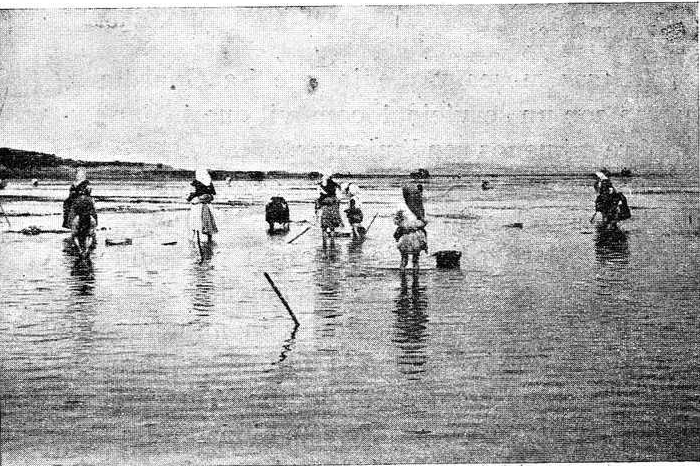
This photo dates from 1909. Compare it with what you will see from the boat today: the boots and clothes have changed, but the scene is almost identical. Women bent over the sand, their backs to the sea, a bucket beside them. Few trades in Europe have stayed so alive and so unchanged for over a century.
Why watch it from a boat (and not from the promenade)
From land you see a small piece. From the water you understand the whole picture. When we leave Vilanova harbour on a falling tide, we pass within a few metres of the banks and you can see the mariscadoras wading in, the rakes working, the buckets filling. A little further on come the Carril clam beds with their marker stakes, the rafts with their ropes thick with mussels, the small boats of the afloat gatherers. It is a complete maritime heritage route in a single morning.
There is another reason: respect. The shellfish banks are workplaces and in many stretches walking on them is forbidden without a permit. From the boat you observe without disturbing, without trespassing and without trampling the young stock. We always pass at a sensible distance and at low speed, because nobody appreciates a boat's wake stirring up the sand.
What you will see on a shellfish-gathering trip from Vilanova
- The banks of Vilanova and As Sinas: right outside the harbour, at low tide, you can see the Vilanova guild working the cockle beds on the beaches and points nearby.
- The Carril clam beds: Galicia's most famous clams grow in plots marked out with stakes, with Illa de Cortegada in the background.
- Mussel rafts between Vilanova and A Illa: we pass between the platforms and, with luck, watch the raft workers hauling up ropes.
- The banks of A Illa de Arousa: the A Illa guild is one of the largest in Galicia. From the O Bao and O Carreirón area you can see the intertidal banks where clams are worked.
- Punta Cabalo lighthouse and Areoso: to finish, a swim or a spell at anchor off Illa de Areoso, with its white sandbank, now in full relax mode.
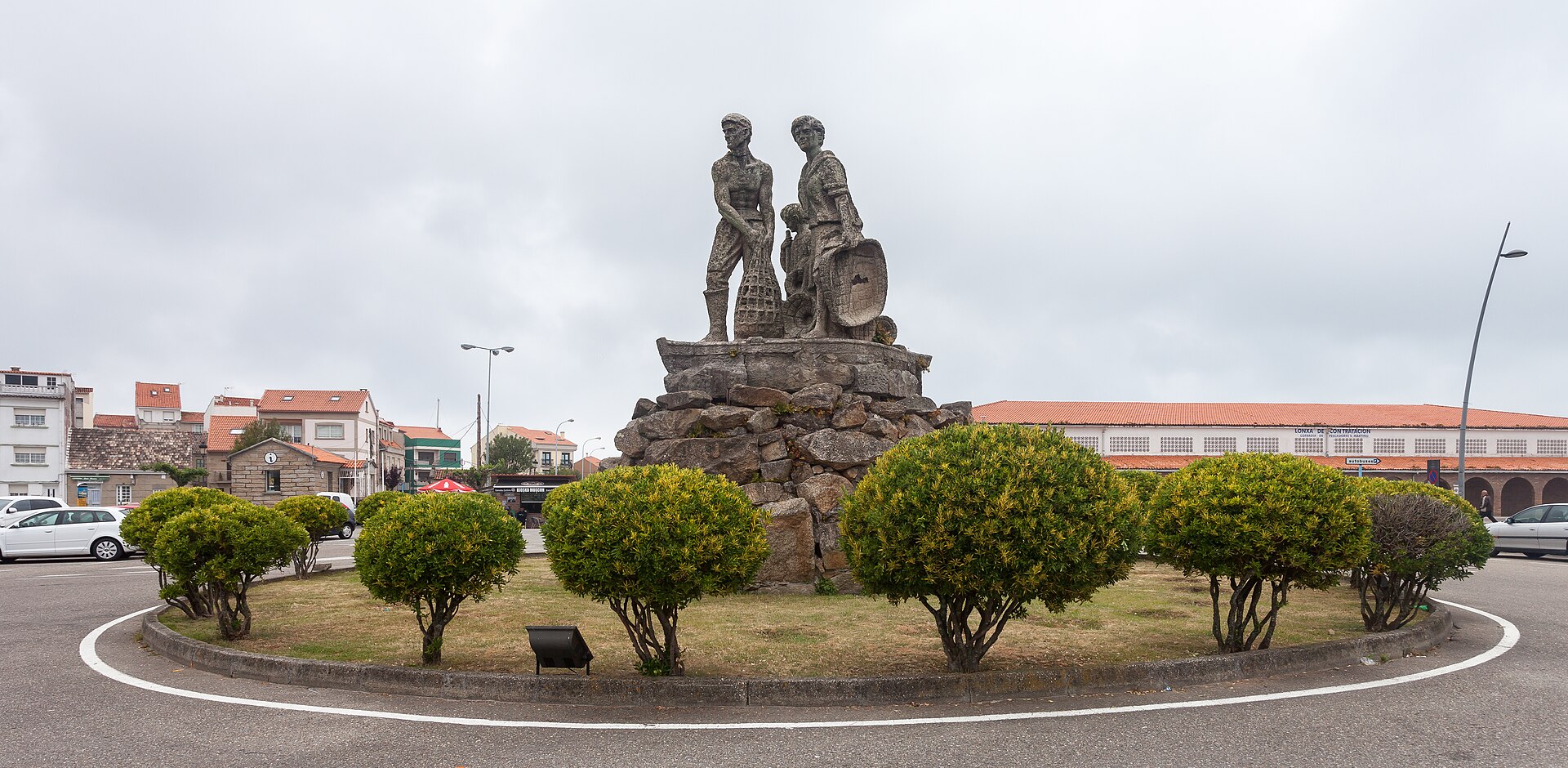
O Grove has had a monument to the shellfish-gathering family since 1972. That is no accident: throughout the ría, seafood is culture, economy and pride. If we extend the trip there on a full day, we see it from the water and can call in at the harbour.
When to go: tides, months and times
This is what people ask us most, and what matters most. Gathering on foot only happens at low tide, ideally on spring tides, when the sea retreats furthest. The guilds work shifts of about four hours around low water, usually weekday mornings.
- Best months: October to March is when cockles and clams are worked most. There is activity in spring and summer too, but many guilds close banks for part of the summer so the shellfish can grow. October, right now, is an excellent time.
- Best time of day: low water. It shifts by about 50 minutes each day. Check the Vilagarcía tide tables or, easier still, tell us which day you want to come and we will tell you what time we sail.
- Best days: weekdays. There is no gathering at weekends, although the beds and rafts can still be seen.
- Weather: in autumn the wind usually eases and the ría is calm in the morning. If it rains, gathering carries on, and we go out in light rain if the sea allows. We cover this in our post on what we do if it rains.
If you want to match your trip to an autumn spring tide, it is best to write to us one or two weeks ahead. We check the tide calendar and suggest the exact day and time.
After watching it, eat it
This is the part that closes the circle. After watching how clams and cockles are harvested, arriving in Carril, Cambados or A Illa and eating them on a harbour terrace transforms the experience. You know where they come from, who gathered them and why they cost what they cost. A plate of Carril clams a la marinera with a glass of Albariño from Cambados is the logical end to a morning of shellfish gathering from the boat. You will find more ideas in our guide to where to eat in the Ría de Arousa arriving by boat.
One tip: the harbours of A Illa and Carril have fish markets where the day's shellfish is sold at midday. If you have time, going in to look costs nothing and is another way to see the trade up close.
Frequently asked questions about shellfish gathering by boat
Can we gather shellfish ourselves? No. Shellfish gathering is a regulated trade: you need a harvesting permit from the Xunta and membership of a guild. Taking clams or cockles "for dinner" is poaching and is fined. What we do is watch and understand, not extract.
Can we talk to the mariscadoras? From the boat we do not disturb them while they work. But if we later go ashore at A Illa or Carril, they are open people who are usually happy to describe their day. Some guilds also run guided visits as part of what is known as maritime tourism, a perfect complement to the boat trip.
Is this trip suitable for children? Absolutely. Children are fascinated by the work on the sand and on the rafts, and the route is gentle, through sheltered waters. Read more in our post on boat trips with children.
How long does it take? The basic heritage route (Vilanova, Carril, mussel rafts, A Illa) fits comfortably into half a day (4 hours). If you want to reach O Grove or Cortegada, or spend the afternoon at anchor off Areoso, we recommend the full day.
Prices and booking
We depart from Vilanova de Arousa harbour with a skipper, on an 8.5 metre boat certified for 10 people that we limit to 6 passengers so everyone travels in comfort.
- Half day (4 hours): 300 €
- Full day: 500 €
- Fuel not included, depending on the route we cover
No licence or experience needed: we are the skipper, and we also act as guide, because we have spent our whole lives watching this estuary at work.
Message us on WhatsApp at +34 685 74 24 20, tell us which day suits you and we will tell you when the tide goes out. We promise that after this trip you will never look at a plate of cockles the same way again.
Photos: Luis Matías López Rivas — CC BY-SA 3.0; Vida Gallega magazine (1909) — public domain; Luis Miguel Bugallo Sánchez (Lmbuga) — CC BY-SA 3.0, via Wikimedia Commons.
Ready to experience the Arousa estuary onboard?
Full day €500 · half day €300 · fuel extra. Book on WhatsApp and we confirm in under 4 hours.
Book by WhatsApp

